
April 2026
Why the Legal Sector is Quietly Having a Moment
The Legal sector has been one of the few stabilizing forces for commercial real estate in the last few years. In London, legal leasings are up 13%, with US firms accounting for a lot of that growth. In the US, more firms are expanding in size vs contracting, but the focus has been on enhancing existing space and targeting moves only when the right location in a class A building becomes available. In either case, firms have their sights set on high quality office space.
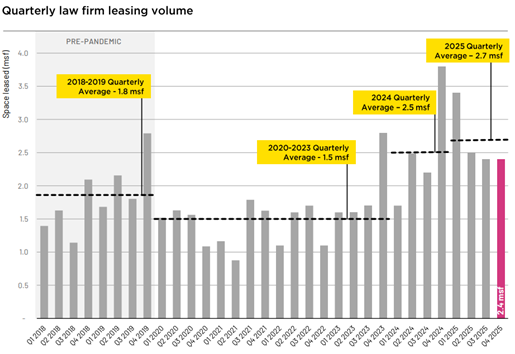
Although there is growth in the sector, individual firms are finding ways to do more with less. There continues to be a steady decline of RSF per attorney as firms look for strategies to optimize their portfolio without significant investment. For a while this was achieved in large part by reducing support staff and file storage. AI continues to reduce the need for those positions but there’s not much space savings left to achieve on those two fronts.
So, what are some of the strategies law firms can enact to create this streamlined yet high quality legal workplace? Ark has a few ideas to based on what we’re seeing across sectors and with recent legal projects.
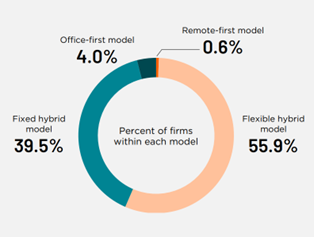
1. Lean into the siloed nature of legal work to maximize office use. Lawyers prefer a private office, but if the firm is on a hybrid schedule of 2-3 days a week, (which by the way 95% of law firms are!) private offices are often going underutilized. These could be given over to meeting space or drop-in space for other attorneys. The key is codifying the attendance policy so that these opportunities can be fully captured. There needs to be a clear agreement amongst attorneys that your private office is only yours when you’re sitting in it.
2. Grow the “drop-in zone”. Support remote workers, or attorneys who may need to stop by for an hour or two before heading to a courthouse. Avoid underutilized offices and instead consider planning spaces that feel like private zones, if not private rooms. Think 6-8 workstations max, with a second separate or secluded zone if needed.
3. Think of the office as a clubhouse. When you come in, you want to see your colleagues and know who is there. This begins with having a high-quality café and the drop-in zone, but might also include working libraries, huddle rooms, and visibility into private offices. You can always do focus work at home; the important thing about the office is the camaraderie with your colleagues.
4. Emphasize learning and development. Legal work is still incredibly important, but the office setting is now more about training younger lawyers and building up skillsets, particularly around AI for all employees. This could mean some formal trainings or lectures in the office. Having a large place for the full firm to gather is more valuable than ever before.
Together these ideas form the basis of the future legal office. One that brings lawyers together to build talent and culture, while maximizing the use of the physical space.