
August 2026
From Individual Amenities to Ecosystems
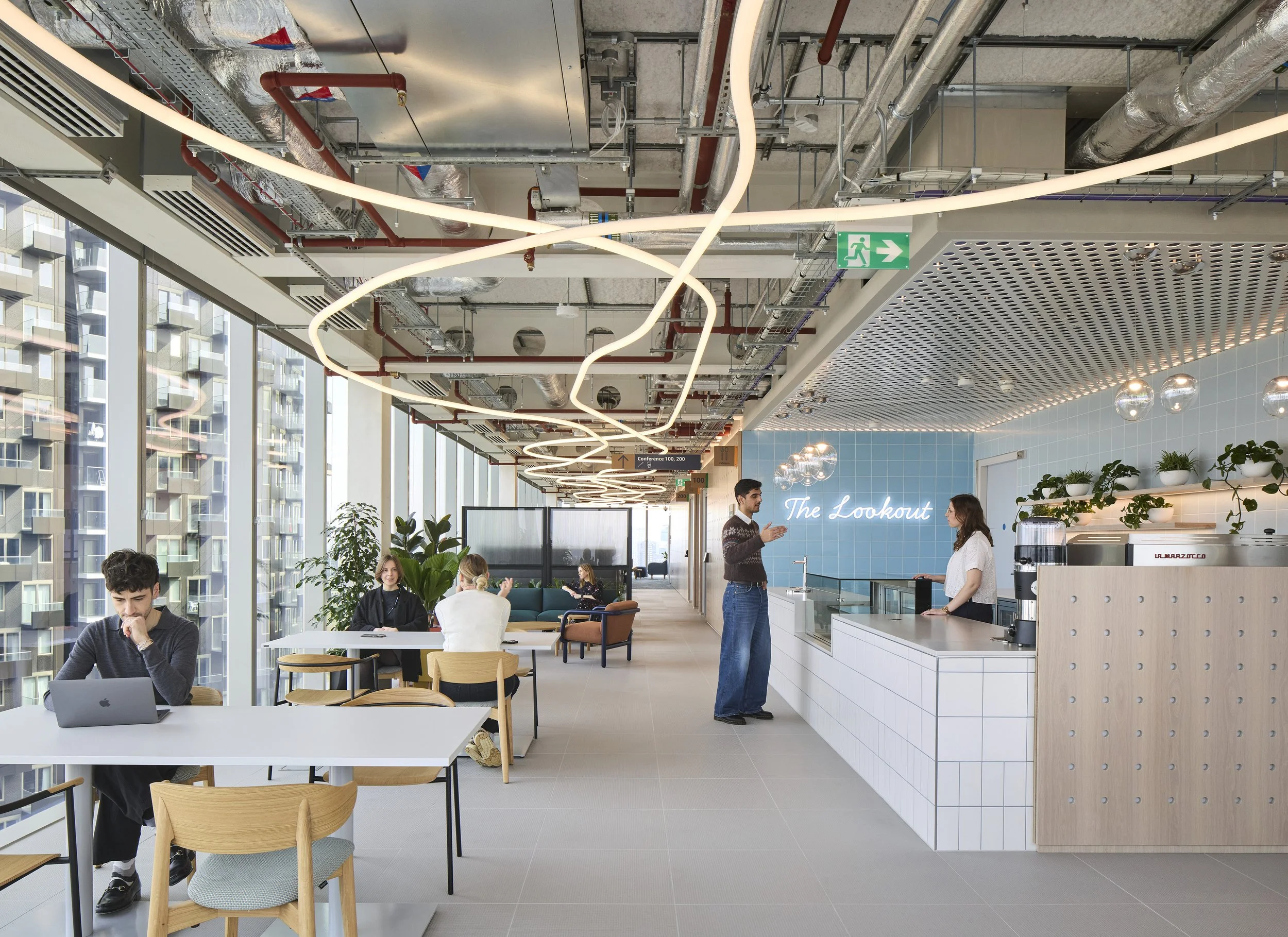
Banking Company Texas
The future of workplace amenities is all about integration. The Banking Company Texas Amenity Masterplan offers an example of this shift, moving beyond a traditional approach to amenities to a more connected and adaptable campus ecosystem. Ark partnered with HLW and Beyond to look at employee experience, attendance, utilization, future headcount projections, and long-term needs, to create a strategy that explores how existing space can be right-sized and reimagined to provide greater value. Our solution was less about adding more amenities and more about creating the right mix of experiences, connections, and flexibility to support the campus.
For this banking client, a clear gap existed between campus capacity and actual amenity utilization. With approximately 12,000 seats, average on-site attendance was ~40%, with peak attendance reaching ~55%. Furthermore, a mere 1% to 2% of the population actually used the current fitness center. Rather than maintaining spaces sized for the total population, we used participation and actual behavior as inputs for future programming. Short-term, this meant improving awareness and program of existing spaces. In the long-term, this meant reallocating underutilized square footage to other functions.
Design for Behavior, Not Capacity
Rather than treating Food, Fitness, Medical, Events and Wellness as individual programs and destinations, we organized them into an interconnected campus ecosystem with the primary goal of drawing talent back to the office while supporting people more holistically through nourishment, connection, renewal, and recharge. With low campus attendance, amenity effectiveness is driven less by scale and more by flexibility, accessibility, and alignment with real patterns of use.
Some of our recommendations & solutions included:
Food strategy supports culture, gatherings and events
Wellness is distributed into everyday circulation, becoming an opportunity for movement, discovery, and social interaction
Health center evolves from a reactive traditional medical clinic toward a broader preventative and holistic health resource
Invest in shared amenities that serve the largest on-site population
Interconnected Amenities
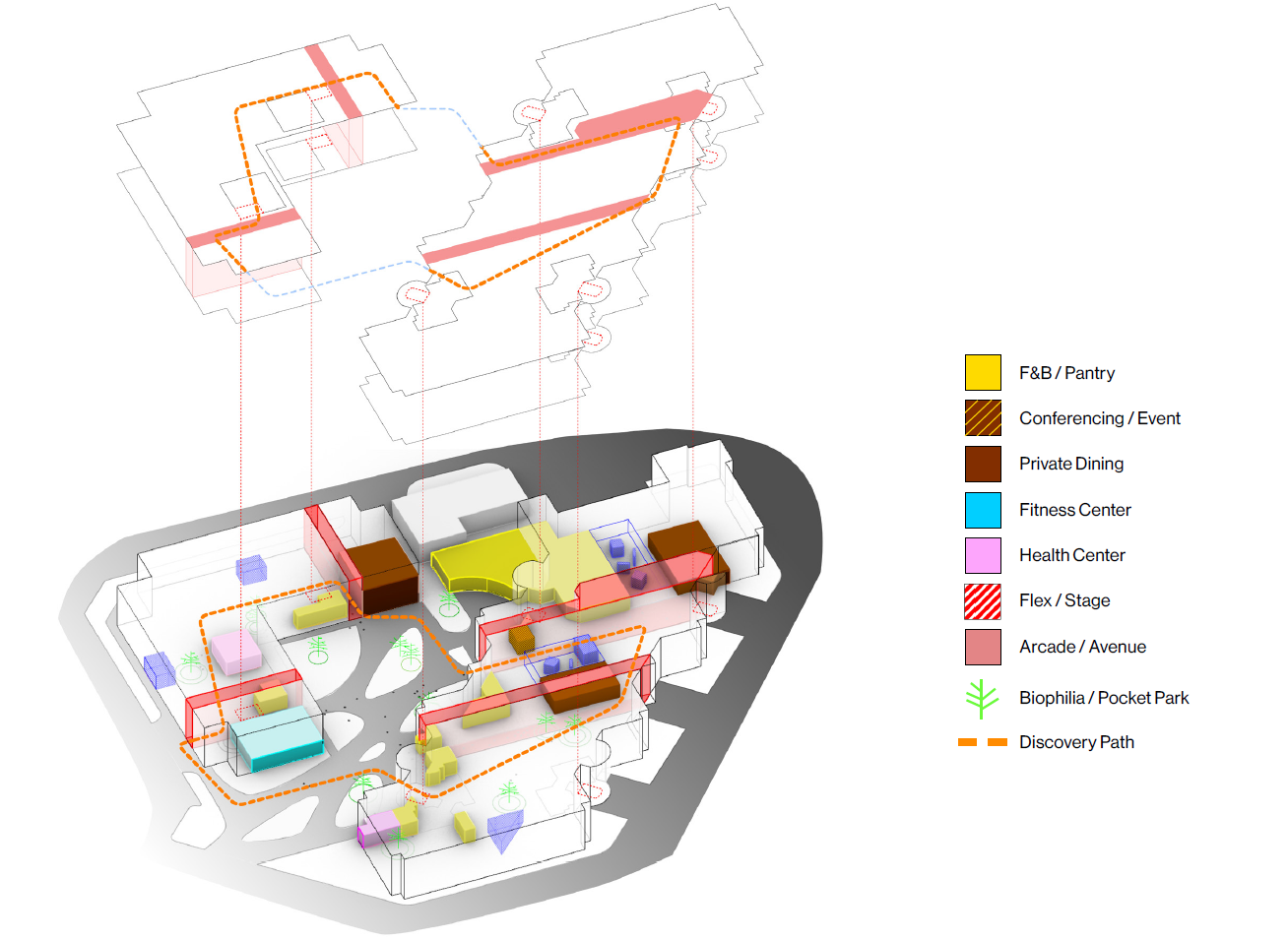
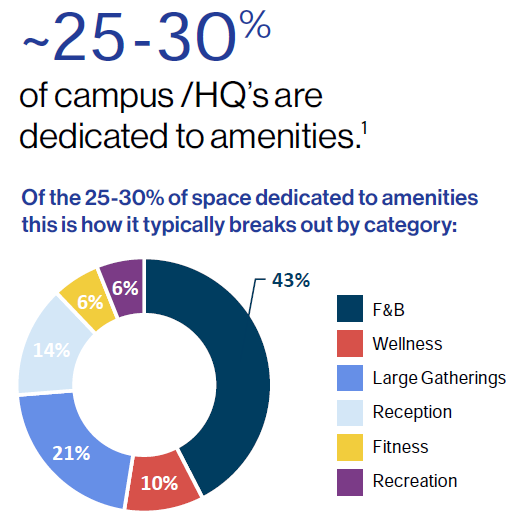
According to Ark’s research, ~25-30% of campus / headquarters are dedicated to amenities. Right-sizing isn’t simply removal of program, but an opportunity to trade underutilized space for experiences that create more value. After reviewing the client's existing data, Ark recommended reducing some single-use program for typologies with a broader campus impact: reduced fitness, wellness and medical areas for significant event spaces, a new arcade, and "discovery path" throughout the campus.
The banking client also asked how this could be applied to broader scaling methodology. Larger headquarters buildings may require additional event, health, and wellness functions, while smaller offices can typically leverage shared or building-wide amenities.
Right-Sizing ≠ Doing Less
The master plan establishes a sequence of amenity improvements that can evolve over 3-5, 5-7, and 7+ years. The short-term phases focus on operational improvements within existing amenities, while the later phases leverage projected headcount reductions to unlock larger and more impactful interventions.
The phased approach connects program + site + climate to incorporate strategies like native planting, shading, natural ventilation, daylight, and solar power. Beyond’s proposed strategy alone is estimated to avoid 2,735 metric tons of CO2 annually.
Future-proofing Means Planning for Change

In Conclusion
The Banking Client Texas competition gave Ark, HLW, and Beyond the opportunity to build a vision not just for how people use the workplace today, but to create an adaptable framework that can continue to evolve with the company.